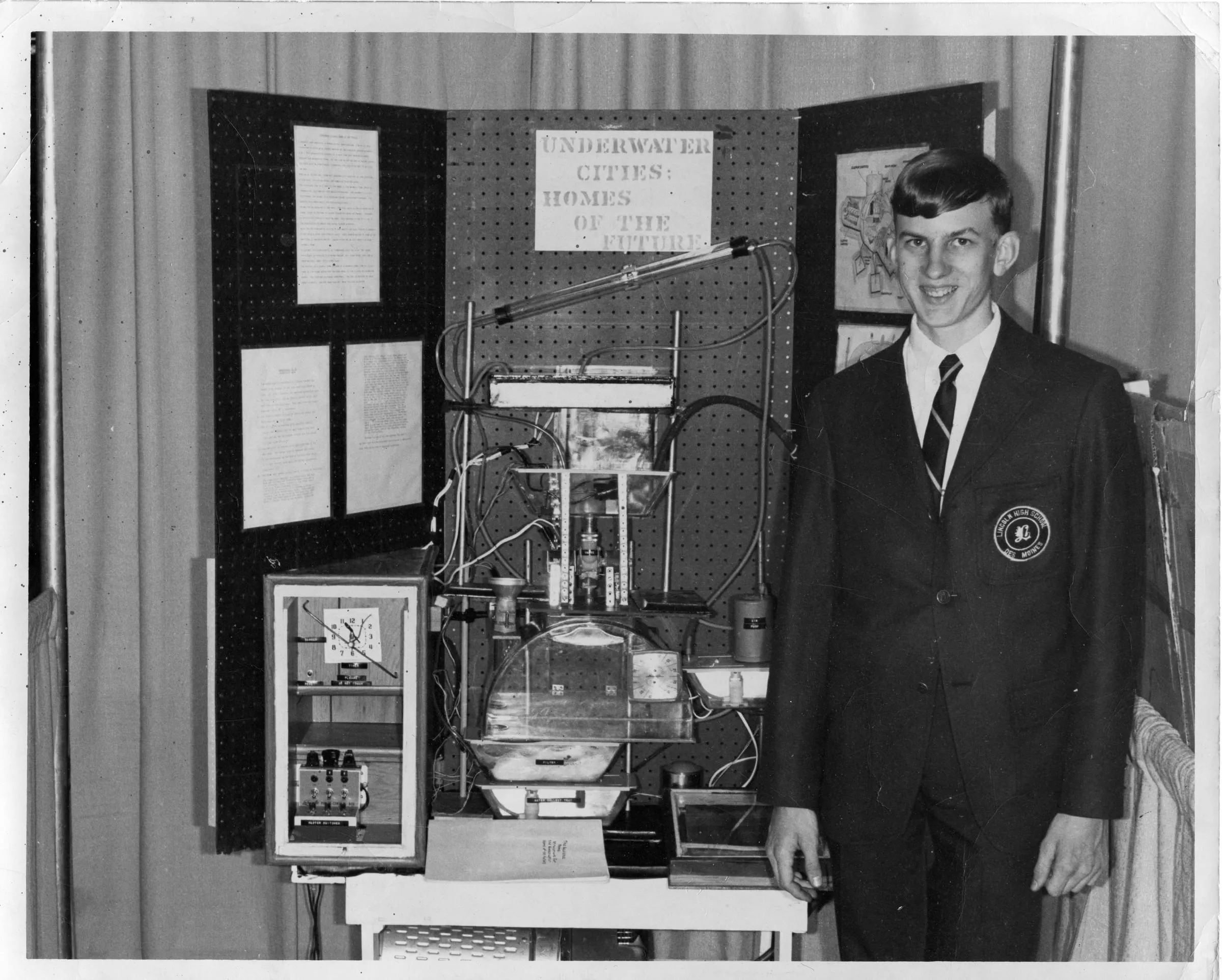
Paul Linden’s story starts, fittingly, with an experiment.
As a high-school sophomore in 1968 he built an ambitious science-fair project titled “Underwater Cities: Homes of the Future” — a working tabletop apparatus of pumps, timers, and hand-wired control panels that imagined how people might one day live beneath the sea. It won the Iowa Hawkeye Science Fair, and Paul went on to be a Finalist at the 19th International Science Fair in Detroit that same year. The photograph of a young Paul standing beside it, in a Lincoln High School blazer, already shows the pattern that would define his career: an idea about how people might experience the world, and a machine built to make it real.
The underwater idea stuck with him. As a 1997 Kansas Alumni profile recounts, Paul first set out to study oceanography at Tulane — where he hoped to build a sustainable underwater city — before changing course and enrolling at the University of Kansas (class of ’75), where he moved through engineering and industrial design and, after reading an article in Rolling Stone, fell for holography.
Laser light as an art medium
By the mid-1970s Paul had found his way to lasers. A 1974 story in the Sioux City Journal, “Holography Explored as Art Medium,” documents Paul and fellow University of Kansas senior Barney Wages adjusting a reflector system as they prepared to make a hologram — “laser-beam photography,” as the paper called it, “its possible uses in art.” It is the earliest known press record of Paul working with the coherent light that would become his life’s material.
The work was recognized on campus. Paul and Barney won research grants from the KU summer undergraduate research program and the KU Endowment fund — a 1974 letter from Chancellor Archie R. Dykes congratulated them both — and the two designed their own mark, hri (Holographic Research & Integration), for the work. Paul went on to be named the outstanding senior in Independent Study in KU’s Department of Design in 1975.
During college Paul also attended several classes at the School of Holography in San Francisco, where he met the holographer Lloyd Cross. The two became friends and worked on and off together on a number of projects over the decades — right up until Lloyd’s passing in 2015.
Armour Amusement
Just after college, Paul went to work with Armour Amusement, servicing and operating commercial entertainment equipment — arcade games, pinball machines, early video games, and coin-operated attractions out on location.
It was an unglamorous but formative education. Armour taught Paul how entertainment technology performs in the real world — not on a workbench, but in a noisy room full of paying guests, where a machine has to be reliable, serviceable, and genuinely fun. That instinct, for engineering measured by the experience it creates, carried straight into everything that followed.