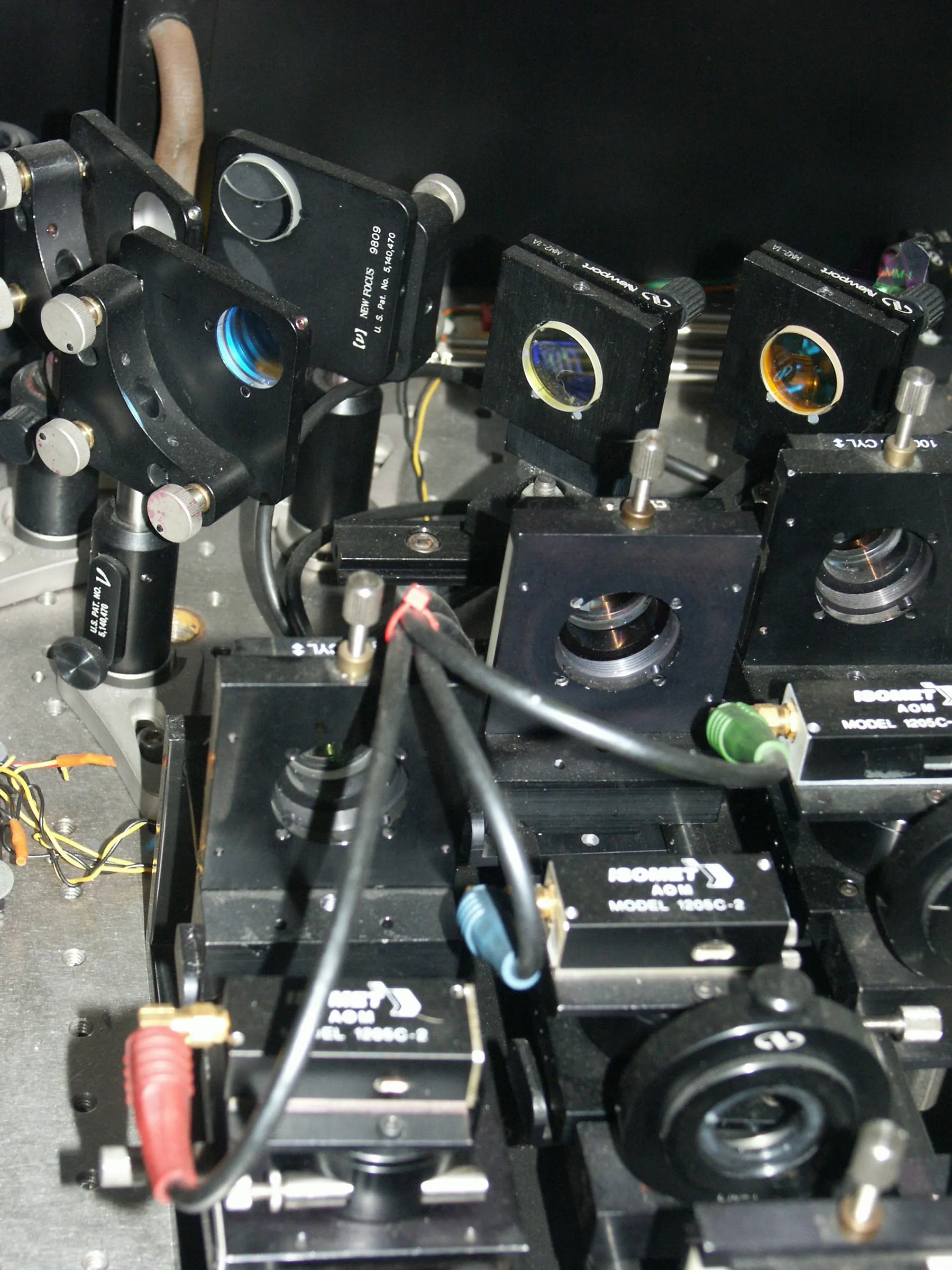
After ShowBiz, Paul turned to the problem that would define him as an inventor: projecting very large, full-color video images using lasers as the light source.
At Advanced Laser Projection — the company he co-founded in Irving, Texas, where he served as Vice President and Director of R&D — Paul used lasers not to read video, the way a disc player does, but to create and cast the image itself.
Why lasers
A conventional projector uses a lamp and a lens, and its image gets dimmer and softer as it grows and as the throw distance increases. Laser light behaves differently. Because the beams are coherent and tightly controllable, a laser-illuminated projector can support:
- very large images,
- long projection distances,
- high brightness,
- a very wide color palette,
- a very high contrast ratio, and
- an unusually large depth of focus across the projection surface — useful for screens that are big, curved, or irregular.
Red, green, and blue laser sources are converged and modulated to build a full-color picture, then scanned and steered onto the screen. The result, in the company’s ProFX and Taurus multi-plane imagers, was projected imagery at a scale conventional projectors of the day could not match — in one demonstration, an image of a car cast large enough for a person to stand beneath it (see the archive).
The patents
The Laser Projection Apparatus patent — U.S. 5,136,426 was developed to maximize the various wavelengths of the two argon lasers and the dye laser, giving the best color balance of the red, green, and blue beams for the brightest, most saturated image. The Image Mover — U.S. 5,365,288 was created with holographer Lloyd Cross and Duane Dewald.
Two patents from this period are fully documented:
“The only machine with an image mover”
A 1997 profile in Kansas Alumni captured just how rare this work was. “Only two of us in the world actually have working laser-video projectors,” Paul told the magazine. “One is in Germany. I’m the other, and mine is the only machine with an image mover.” His systems used three lasers — a dye laser for red, argon lasers for green and blue — mixed to project full-color video from any standard tape, onto almost any surface.
The applications were as vivid as the technology: for Universal Studios Florida’s Halloween shows, Paul projected full-motion video onto a 90-foot- diameter water screen built by Fantastic Fountains of Tampa, every inch in focus; his images were thrown onto a football helmet for an ESPN promo and splashed across a conference room at an MCI shareholders’ meeting at the Kennedy Center — as well as mall openings and custom theatres in Japan.
One moment Paul is especially proud of: his laser video ran the big screen at the gala for the 1991 Collier Trophy — aviation’s top honor — in Washington, D.C., honoring the Northrop/industry B-2 team, with the Marine Band and military leadership in attendance. (The projection was on the screen, not on the aircraft — a detail the contemporary press sometimes blurred.)